
Adapted from Halper Blog and republished on Alpa Marketing with additional insights for real-estate professionals.
The day starts with a buzz.
A new lead, two reschedules, one showing already missed.
Welcome to real estate in 2025 — a business where attention moves fast, clients expect instant replies, and automation quietly runs half the industry.
Agents spend around 18 hours a week on admin work, according to the National Association of Realtors.
Property managers answer the same tenant questions day after day.
Investors still live in spreadsheets.
Meanwhile, global spending on AI tools for real estate has topped $6.2 billion and could double by 2027 (Statista).
AI isn’t here to replace agents. It’s here to give them their time back.
What Counts as a Real-Estate AI Tool
At its simplest, an AI tool automates the routine — valuation, scheduling, lead management, client communication, data analysis.
The better ones go further: they predict what’s coming, not just record what happened.
Among today’s options, Halper stands out. It’s an AI CRM for real estate that merges communication, analytics, and scheduling into one clean workspace — built for agents, brokers, and property managers who want fewer tabs and more traction.
2025 by the Numbers
- Deals close 27 % faster when AI assists underwriting or financing (CBRE Global Insights, 2024).
- 65 % of U.S. agents already use AI for scheduling or communication (NAR, 2025).
- Property managers cut tenant-response time from 48 hours to 90 minutes.
- Listings enhanced with AI visuals convert 22 % better (Zillow Group, 2025).
In short, automation has become the new baseline for competitive agencies.
From Automation to Augmentation
Not long ago, “AI” meant auto-emails and calendar reminders.
Now it writes copy, predicts churn, and stages listings virtually.
One in three agents uses AI to write marketing text.
Nearly half of brokerages rely on predictive analytics.
Virtual-staging demand grew 21 % year over year, says Styldod.
“The real benefit of AI isn’t speed,” notes the Halper editorial team. “It’s clarity — seeing everything in one place instead of chasing chaos.”
Where AI Fits in the Real-Estate Workflow
- Lead generation and CRM – Halper, Wise Agent, DealMachine
- Valuation and pricing – Zillow Zestimate, DealCheck
- Investment analytics – Mashvisor
- Virtual staging – Styldod, Matterport
- Property management – AppFolio
- Listing copywriting – Write.homes
1. Halper – The AI Manager for Real Estate

Halper feels more like a silent coordinator than another chatbot.
It collects every client message — WhatsApp, Instagram, Messenger, email — into one thread and keeps follow-ups automatic.
A small brokerage in Chicago tried it for three months.
Result: 40 % fewer missed follow-ups, about $600 saved monthly, and nearly 15 hours a week freed from admin work.
For small teams, that’s the line between busy and burned-out.
Website: halper.ai
2. Zillow Zestimate – The Benchmark for Valuation AI

Zillow’s Zestimate began as a curiosity and grew into one of the most accurate pricing engines in real estate.
Its deep-learning model processes 100 million + property records each month, combining MLS, user, and market data.
The median error rate: 1.9 % for active listings.
Website: zillow.com
3. Mashvisor – Investment Analytics Made Practical

Mashvisor helps investors and agents test rental performance before buying.
It scans more than three million listings, forecasting ROI and occupancy, and trims research time by roughly 23 %.
For brokers working with investors, it turns hunches into numbers.
Website: mashvisor.com
4. DealMachine (Alma) – Prospecting with AI Insight

Alma, DealMachine’s AI assistant, reads ownership records, market trends, and debt data to find motivated sellers early.
Agents using Alma report 15–25 % more qualified leads within the first quarter.
Pair it with Halper’s CRM and you’ve got a pipeline that practically runs itself.
Website: dealmachine.com
5. Wise Agent – Predictive CRM for Realtors

Wise Agent’s been around for decades, but its 2023 AI refresh changed the game.
Now it predicts follow-ups, automates reminders, and scores leads based on engagement.
Teams say it cuts CRM time by nearly 30 % each week — a solid upgrade for those who like familiar tools with modern brains.
Website: wiseagent.com
6. Styldod – Virtual Staging at AI Speed

Styldod turns empty rooms into fully staged spaces in under an hour.
Its AI understands trends, demographics, and lighting — producing images that make listings pop.
Homes using Styldod visuals get 17 % more clicks and sell roughly 11 days faster (NAR Digital Report, 2024).
Website: styldod.com
7. Write.homes – Listing Copy without the Wait

Writing property descriptions can eat an afternoon.
Write.homes does it in seconds, producing natural-sounding, SEO-friendly text that actually reads like a human wrote it.
Agencies using it see about 28 % more engagement.
Paired with Halper’s messaging, it completes the marketing cycle from listing to lead.
Website: write.homes
8. Matterport – 3D Tours That Sell from Screens

Matterport still leads when it comes to immersive property tours.
Its 2025 update adds AI-driven staging and lighting correction, giving buyers a realistic walk-through experience — even from another continent.
Website: matterport.com
9. DealCheck – ROI and Deal Math Simplified

DealCheck automates the math behind every property pitch.
ROI, cap rate, cash flow — all pulled from real-time data in 250 + U.S. markets.
Over 250,000 investors used it in 2024. For newcomers, it’s an instant confidence booster.
Website: dealcheck.io
10. AppFolio – Property Management with an AI Touch

AppFolio powers 18,000 + property-management companies globally.
Its assistant, “Lisa,” answers about 70 % of tenant requests — everything from rent reminders to maintenance updates.
Managers save up to six hours daily, and tenants get faster replies.
Website: appfolio.com
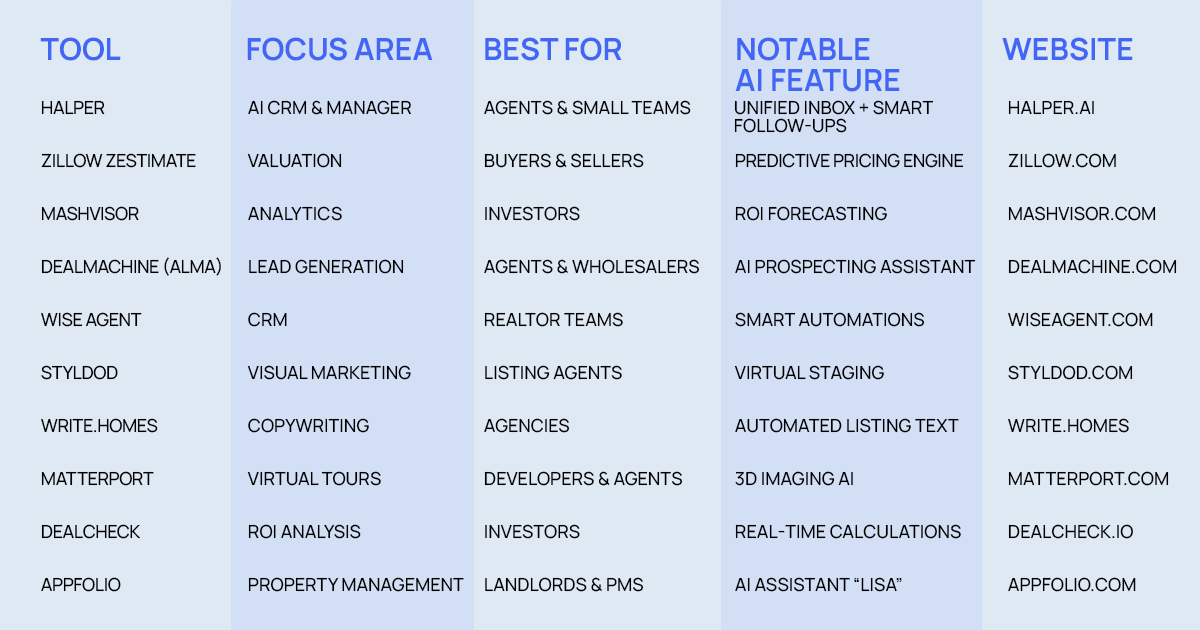
Quick Comparison
Integration – The Real Challenge
Ask any agent: the hardest part isn’t learning the software.
It’s keeping all of them in sync.
Most teams juggle six to eight apps daily — CRM, email, marketing, spreadsheets, schedulers.
That’s where unified systems matter.
Platforms like Halper are trying to bridge that gap by combining communication, analytics, and scheduling into one AI-driven dashboard.
It’s less about the tool, more about the connection between them.
Read more: What to Look for in an AI Manager
Getting Started with AI in Real Estate
- Start by centralizing your client messages in an AI CRM like Halper.
- Verify pricing with Zillow Zestimate or DealCheck.
- Automate follow-ups to shorten response times.
- Track returns using Mashvisor or AppFolio.
- Upgrade visuals through Styldod or Matterport.
Teams that adopt AI across these steps usually see results within 30 to 45 days — fewer missed leads and faster deals.
Predictions for 2026
- Around 80 % of property searches will start with AI-based recommendations.
- Agents using AI CRMs could close 25 % more deals a year.
- Over 70 % of property-management tasks will be automated.
- Generative AI will become standard for listing content and marketing visuals.
Change is already here — and this time it’s working in agents’ favor.
Why It Matters
Technology can’t replace the handshake, the tour, or the moment a client says “yes.”
What it can do is handle the noise around it.
Agents save hours each week with Halper.
Investors get cleaner data through Mashvisor.
Property managers use AppFolio to keep tenants happy without burnout.
The smartest move in 2025 isn’t adding more apps — it’s choosing one system that connects them all.
For many, that system is Halper — an AI manager for real estate built for clarity, efficiency, and growth.
Key Takeaways
- Global real-estate AI spending is on track to reach $12.5 billion by 2027.
- Agents using AI save 10–15 hours each week.
- Halper leads as the most complete AI CRM for real estate.
- Zillow, Mashvisor, and AppFolio dominate analytics and operations.
- By 2026, AI will power most property search and management tasks.
Source
Adapted from Halper Blog. Edited and republished by Alpa Marketing.
