
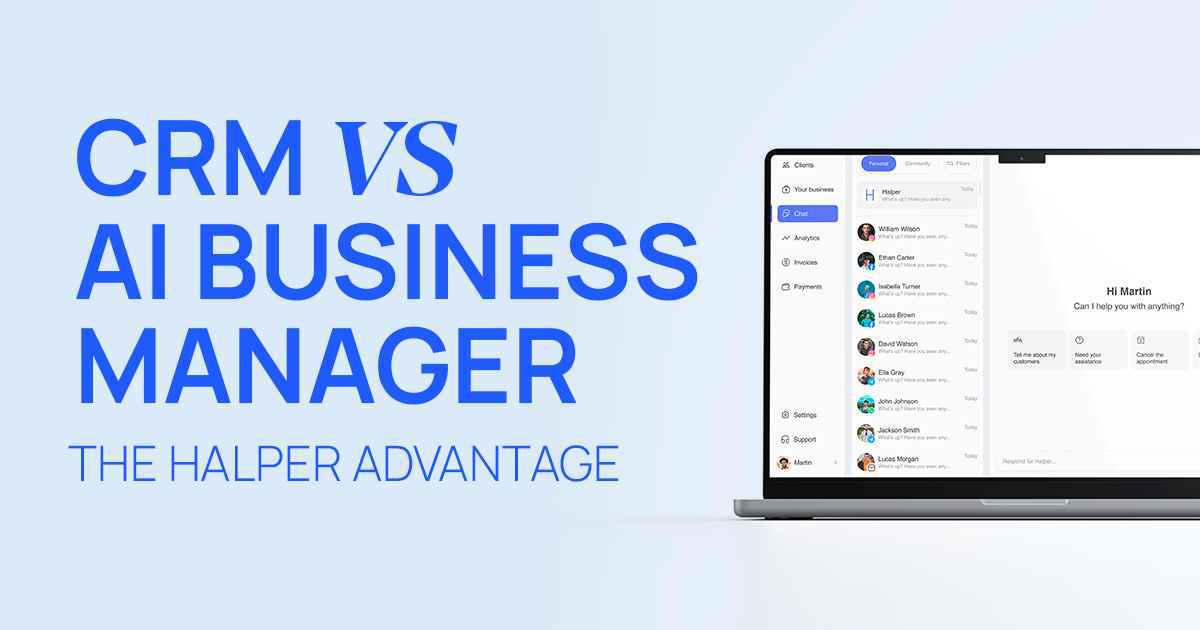
Adapted from Halper Blog and republished on Alpa Marketing with additional insights for solopreneurs and service-based small businesses.
There’s a moment most small business owners recognize instantly.
You finally install the CRM everyone recommended. You open the dashboard. You admire the tabs. You enter a few contacts. Everything looks organized, professional, promising.
And then, quietly, you go back to running your business from your phone.
Not because the CRM is bad.
Because it doesn’t actually run anything for you.
CRMs were built for structured sales teams. Solopreneurs and service professionals live in a different reality. Clients DM on Instagram, send voice notes on WhatsApp, reschedule on Facebook, and forget appointments unless something reminds them at exactly the right moment.
That gap is why a new category emerged: the AI Business Manager.
Halper, available at site, sits right at the center of it.
Here’s how the difference shows up in real work.
CRMs Store Information. AI Managers Move Work Forward.
A CRM behaves like a well-organized archive. It keeps data visible and tidy, then waits for you to act.
An AI Business Manager does the opposite. It notices activity and moves things forward automatically.
Halper replies to messages, follows up with clients, handles booking requests, and manages conversations across every connected channel, including those supported here.
Salesforce reports that 66 percent of customers expect responses within minutes. Traditional CRMs were never designed for that kind of real-time pressure. AI Managers were.
And the difference becomes obvious as soon as your calendar fills up.
CRMs Tell You What Happened. AI Managers Act Before You Ask.
A CRM shows you a cold lead.
Halper reactivates it.
A CRM shows you a missed appointment.
Halper prevents the no-show with automated reminders.
A CRM lists overdue follow-ups.
Halper sends them before you even notice they’re needed.
Square reports that missed appointments cost service businesses billions every year, and nearly half of no-shows happen simply because people forget. Halper handles that forgetfulness automatically.
A real example from daily work:
A beauty professional who used to lose evenings answering DMs connected her channels to Halper. Within a week, most of her messaging was automated, booking gaps disappeared, and her schedule stabilized.
That’s what operational support actually feels like.
CRMs Rely on You. AI Managers Protect Your Time.
QuickBooks found that small business owners lose more than four hours a day to administrative work. McKinsey estimates that roughly a quarter of the workweek disappears into manual tasks.
A CRM adds structure.
Halper removes friction.
Halper manages:
-
bookings
-
reminders
-
rescheduling
-
cancellations
-
client profiles
-
multi-channel messaging
-
follow-ups
-
lead nurturing
Zendesk reports that 70 percent of customers prefer businesses that offer fast automated replies. With Halper, fast isn’t an effort. It’s the default.
More strategies for stabilizing schedules and reducing no-shows are available on the Halper blog.
Once these systems run on their own, the business feels noticeably lighter to manage.
CRMs Centralize Data. AI Managers Centralize Operations.
To be fair, CRMs do one thing very well. They organize information.
But information alone doesn’t keep a business running.
Halper unifies messaging, scheduling, reminders, leads, analytics, and workflow automation in one place. Instead of waiting for you to trigger actions, it handles the daily micro-tasks that quietly drain time.
Everything flows through connected channels, reducing the number of apps, tabs, and opportunities for things to fall through the cracks.
A CRM documents your operations.
Halper operates them.
That difference becomes decisive as your client list grows.
CRM vs AI Business Manager: A Practical Comparison
How communication works
CRM: You reply manually.
Halper: Replies are automated across all connected channels.
How scheduling is handled
CRM: You track bookings and send reminders yourself.
Halper: Appointments are booked automatically, with reminders and no-show recovery built in.
How work flows
CRM: Reactive. You act after something happens.
Halper: Proactive. Actions happen as signals appear.
How much effort is required
CRM: Needs constant input and upkeep.
Halper: Runs tasks independently in the background.
This is why many solopreneurs feel they “outgrow” CRMs long before they outgrow their business.
The Takeaway
CRMs explain what already happened.
AI Business Managers shape what happens next.
If your CRM feels like homework, it’s not a personal failure. It’s a category mismatch.
Halper is built for people who run entire businesses from their phones, between appointments, often without a team. It handles the repetitive work that quietly steals time from the work you actually care about.
When manual effort disappears, two things return immediately: time and clarity.
Halper doesn’t just store data.
It manages the day, so you can manage the business.
Follow Halper
Instagram | TikTok | Facebook | LinkedIn | YouTube | X / Twitter
Source: Adapted from Halper Blog. Edited and republished by Alpa Marketing.
