
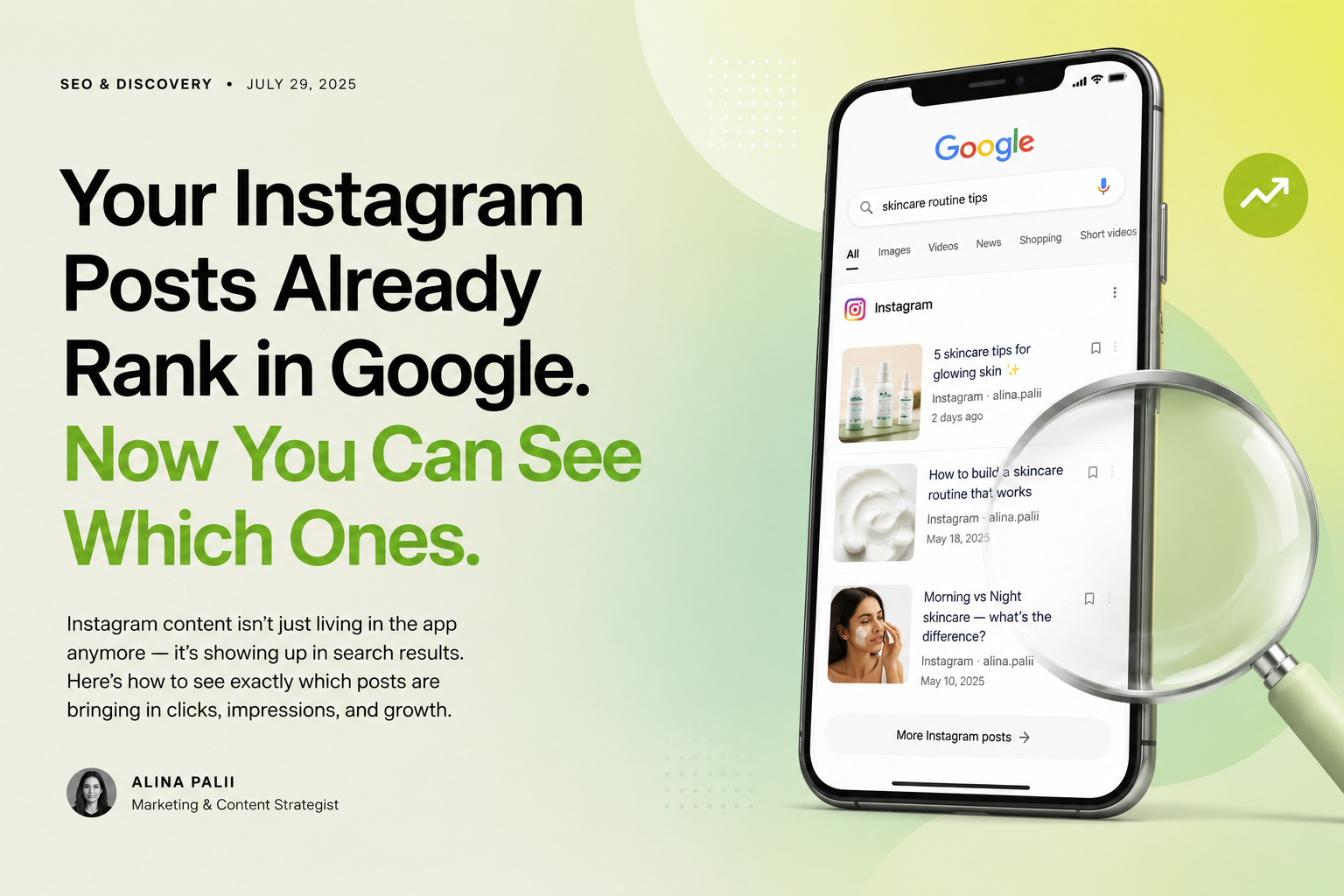
Here’s something most people running a social account have never considered: your posts have been appearing in Google Search results for years. Someone types a question, your carousel surfaces, they read it, and they may never open Instagram at all.
Until July, that traffic was completely invisible. Instagram’s insights show in-app performance. Google’s data was reserved for people who owned a website. If you were a creator, a consultant or a small brand operating entirely on social, an entire discovery channel existed with no reporting attached to it.
On July 7, 2026, Google Search Central announced platform properties — a new Search Console property type — and made it globally available on July 29.
It’s free, it takes minutes, and almost nobody has set it up yet.
What it actually does
Platform properties let you see how your posts on Instagram, TikTok, X and YouTube perform in Google Search, Discover and News.
The significant part is structural: this is the first Search Console property type that can be verified without owning a domain. Every previous version of this tool required a website. This one doesn’t.
You get three reports:
Performance — clicks, impressions, click-through rate and average position. The same metrics site owners have had for a decade, now applied to your social content.
Insights — trends and your top-performing posts on Google surfaces.
Achievements — milestones over rolling 28-day windows.
Data appears within roughly 48 hours of verification.
Why this is bigger than it sounds
The reason to care isn’t the dashboard. It’s what the dashboard reveals.
Right now you almost certainly optimise social content for the social platform: hook in the first line, retention, saves, shares. Reasonable — that’s where the distribution comes from.
But a share of your audience is finding that same content through a search query. They asked Google a question. Your post answered it. That interaction has different mechanics entirely: it’s driven by the words in your caption, the clarity of your framing, and how well your content matches an explicit question rather than a scroll.
You have never been able to see which questions those were. Now you can.
That single dataset changes three things:
Caption strategy. If a post is pulling search impressions, its caption is doing work you didn’t design it to do. Write the next one knowing that.
Content planning. The search queries bringing people to your posts are direct evidence of what your audience wants explained — sourced from actual behaviour rather than from a comment section or your own assumptions.
Repurposing decisions. A post with strong search visibility is a candidate for expansion into a longer format. A post that performed well in-app but has no search presence is telling you something different about its shelf life.
Where this connects to AI search
There’s a second-order effect worth understanding.
Content that performs on Google’s surfaces is content Google’s systems have already assessed and ranked. As AI-generated answers become the default response to every query — which they now are — the material feeding those answers is drawn from what Google surfaces and trusts.
Meanwhile, the click economics keep tightening. SparkToro and Similarweb research found that in the first four months of 2026, 68.01% of U.S. Google searches ended without a click to anywhere, up from 60.45% in 2024.
So visibility on Google surfaces is worth tracking even when it produces no click at all. Being seen, being cited, and being the source behind an answer are now outcomes in their own right — and this is the first free tool that lets a creator without a website measure any of it.
The limits, stated plainly
It measures Google surfaces only. Impressions here are Google impressions, not views inside Instagram or TikTok. The two datasets answer different questions and shouldn’t be added together.
LinkedIn is not supported. If LinkedIn is your primary channel, this doesn’t cover you yet.
There’s a data lag. Roughly 48 hours after verification before anything appears, and the usual Search Console reporting delay after that. This isn’t a real-time tool.
Verification is per platform. Each account you want tracked needs setting up individually.
What to do this week
1. Verify your accounts. Instagram, TikTok, X, YouTube — whichever you actively publish on. Free, and the only cost is a few minutes.
2. Wait a week, then read the queries. The first genuinely useful output is the list of search terms leading people to your content. Most people are surprised by it.
3. Rewrite captions on your best-performing search posts. If a post is already surfacing for a query, sharpening the language around that query compounds an advantage you already hold.
4. Build content from the query list. These are questions your audience is actively asking, in their own words, with volume attached. That’s better input than any brainstorm.
5. Check it monthly, not daily. Search data moves slowly. Treat it as a quarterly planning input rather than a performance dashboard.
Why this matters for small operators specifically
Constant Contact’s February 2026 survey of more than 1,500 small business owners across Australia, Canada, New Zealand, the U.K. and the U.S. found 68% expect social posts and paid advertising to deliver the most value in 2026. LocaliQ data from July 2026 found 83% name referrals and word of mouth as their main source of customers — up from 65% a year earlier.
That’s a market where most businesses are concentrating effort on social and reputation, and where very few have a website doing meaningful search work.
Which is exactly the gap platform properties fills. For the first time, a business operating entirely on social channels can see its search performance with the same instrumentation a company with a full web presence has had for years.
The advantage won’t last. Tools this useful and this free get adopted. But right now, in the first month of global availability, the number of small brands who have set this up is very close to zero.
About the author
Alina Palii — brand strategist, founder of ALPA Marketing.
She works with founders and leadership teams on the decisions that come before the marketing: what the brand stands for, who it is genuinely for, what it declines to be, and how that translates into everything the market eventually sees. Strategy first — the content, the channels and the campaigns follow from it.
10+ years in marketing and a master’s degree in the field. She has built brands from zero for AI startups and national companies, and shaped the positioning of personal brands whose audiences buy on trust rather than on price.
Ukrainian by origin, living between Dubai, Paris and Ukraine, and working across the UAE and European markets — a vantage point that matters when a brand has to hold its meaning across cultures rather than be rebuilt in each new one.
She works across categories rather than inside one. Positioning logic travels between industries even when the audience doesn’t, and the pattern recognition that comes from moving between them is often what a category-blind competitor is missing.

Alina takes on a limited number of strategy engagements at a time.
