
There’s a specific kind of media buyer who built a career on audience construction. Layered interests, lookalike percentages, exclusion lists, careful demographic sculpting — the craft of deciding exactly who should see the ad.
Meta has been quietly removing the value of that skill for two years. With Andromeda, its retrieval and recommendation system, combined with Advantage+, the removal is close to complete.
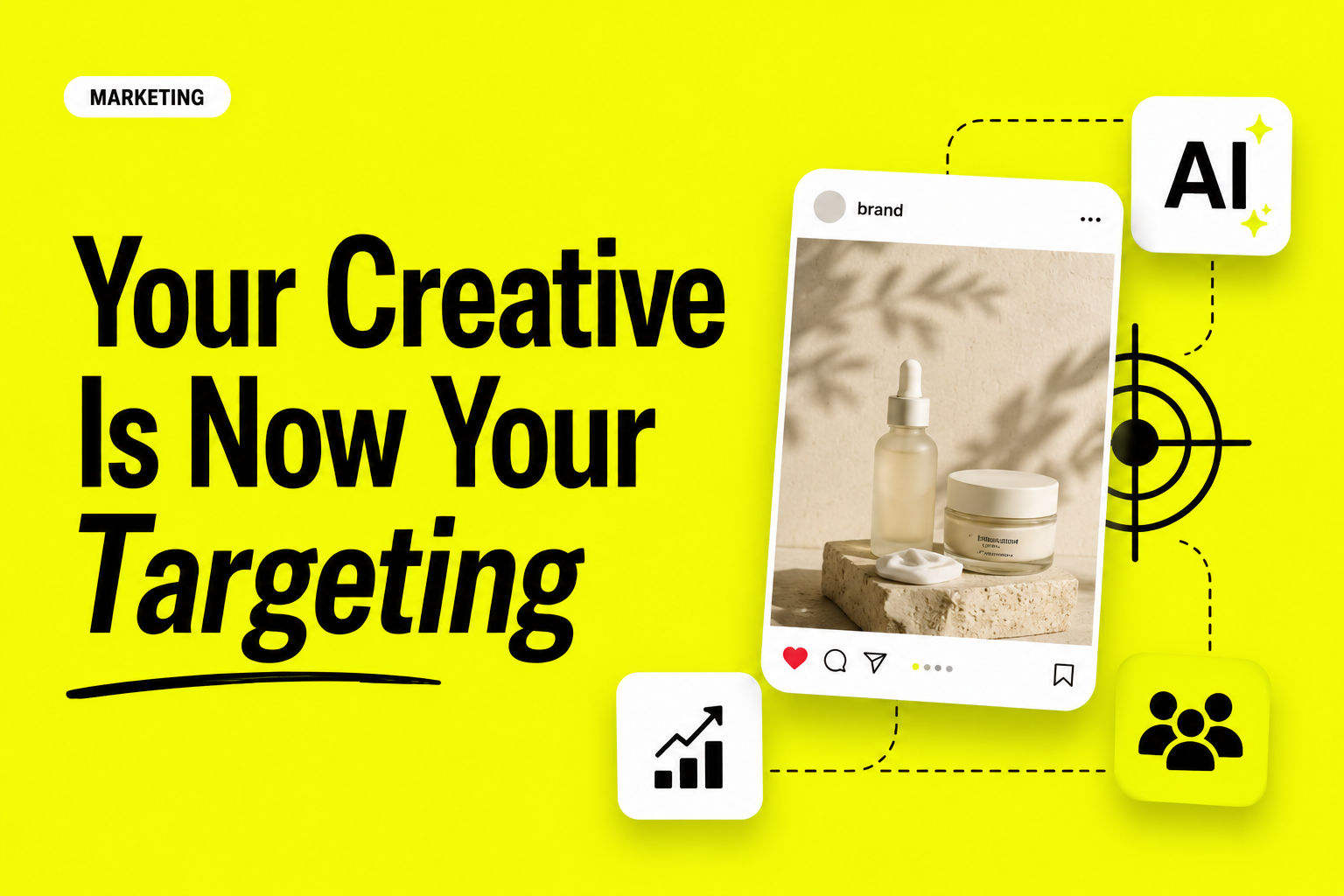
The system now decides who sees your ad. And the primary thing it reads to make that decision is the creative itself.
That’s not a workflow change. It’s a change in what the job is.
What Andromeda actually does
Andromeda is the retrieval layer sitting underneath Meta’s ad delivery: the system that decides, from an enormous pool of candidate ads, which ones to consider showing a given person at a given moment.
Meta reports that Andromeda delivered a 6% improvement in recall and up to 8% improvement in ad quality in specific segments.
The practical consequence: manual microtargeting has lost most of its value. The system reads your creative — what’s in it, what it’s about, who responds to it — and matches it to people, at a scale and speed no manual audience build can approach.
Which means the two remaining levers are creative variety and the quality of your conversion data. Everything else you used to control has been absorbed into the model.
Why creative variety became the strategy
If the system decides who sees the ad based on the ad, then the range of creatives you supply is effectively the range of audiences you can reach.
One creative, however good, is one door. It resonates with one kind of person, in one emotional register, addressing one objection. Give the system twelve genuinely different creatives and you’ve given it twelve doors — and it will find the people behind each one.
«Different» means different, though. Twelve colour variations of the same image is one creative with a paint job. Real variety spans:
- Format — static, video, carousel, UGC-style, text-led
- Angle — problem-first, outcome-first, objection-handling, social proof, comparison
- Tone — plain and functional versus aspirational versus humorous
- Subject — the product, the person using it, the result, the alternative to it
Each of those hits a different mental state. The system can only route to a mental state you’ve actually produced an ad for.
There’s a useful coincidence here. As covered in our piece on production costs, generating a dozen executions now costs roughly the price of a coffee. The platform started demanding creative volume at almost exactly the moment creative volume stopped being expensive.
The other lever: clean signals
The second thing the system needs is accurate information about what happened after the click.
That means Pixel and Conversions API working together, with deduplication configured properly and the events that matter to your business actually firing. Not just purchases — the qualifying steps ahead of them.
This is unglamorous and it’s where most small accounts are quietly broken. An optimisation system is only as good as its feedback. If your conversion data is patchy, delayed, or measuring the wrong event, Andromeda is optimising confidently toward the wrong thing — and it will do so very efficiently.
Time spent fixing tracking now returns more than time spent restructuring campaigns.
The honest caveat for small budgets
Automated systems learn from volume. That’s the mechanism, and it’s also the problem.
An advertiser with substantial daily spend and a high conversion count gives the model a rich signal, quickly. An advertiser with a modest budget and a handful of conversions a week gives it very little — and long learning cycles are genuinely harder to get through at small scale.
If that’s your situation, the realistic adjustments:
Consolidate. Fewer campaigns and ad sets, more spend concentrated in each. Splitting a small budget across many structures starves every one of them.
Optimise for an event that actually occurs. If purchases are rare in your account, a well-chosen upper-funnel event gives the system more to learn from — as long as it genuinely correlates with revenue rather than just being frequent.
Give it time before judging. Reading performance too early and intervening is the most common way small accounts prevent the system from ever stabilising.
Change creative, not settings. When results disappoint, the productive response is new creative angles. Audience tinkering mostly just resets learning.
What actually changed about the job
The media buyer’s work used to be upstream of the creative: define the audience, then commission the asset that speaks to them.
Now it’s the reverse. You produce the range of things worth saying, and the system finds who each one belongs to.
Which makes the valuable skills judgment about what to say, the ability to generate genuinely distinct angles, and the discipline to maintain clean measurement. Not audience architecture.
That’s uncomfortable for anyone whose expertise was in the interface. It’s good news for anyone whose expertise was in understanding customers — because knowing what twelve different people need to hear before they buy is now the entire competitive advantage.
What to do this month
Count your live creative angles. Not assets — angles. If everything running says roughly the same thing in the same tone, you’re reaching one audience regardless of your targeting settings.
Audit tracking before anything else. Pixel and CAPI both firing, deduplication correct, the right events configured. Fix this before optimising anything downstream.
Loosen your audiences. Narrow definitions constrain a system built to search broadly. Restrictions you added for control now mostly reduce reach.
Build a creative pipeline, not a creative project. The requirement is continuous variety, not a quarterly batch. Structure production accordingly.
Judge at the creative level. Which angle earned delivery, and which one didn’t? That’s the only diagnostic left that you can act on.
About the author
Alina Palii — brand strategist, founder of ALPA Marketing.
She works with founders and leadership teams on the decisions that come before the marketing: what the brand stands for, who it is genuinely for, what it declines to be, and how that translates into everything the market eventually sees. Strategy first — the content, the channels and the campaigns follow from it.
10+ years in marketing and a master’s degree in the field. She has built brands from zero for AI startups and national companies, and shaped the positioning of personal brands whose audiences buy on trust rather than on price.
Ukrainian by origin, living between Dubai, Paris and Ukraine, and working across the UAE and European markets — a vantage point that matters when a brand has to hold its meaning across cultures rather than be rebuilt in each new one.
She works across categories rather than inside one. Positioning logic travels between industries even when the audience doesn’t, and the pattern recognition that comes from moving between them is often what a category-blind competitor is missing.

Alina takes on a limited number of strategy engagements at a time.
